
Jul 10, 2026 · By Eliam Marrero Bernal
Rey Vicente Anglada's Last Out
A 1982 Bohemia photo of a “doubtful out” was among the last times Cuba's press showed Rey Vicente Anglada before he was accused, jailed and erased for nearly 20 years.

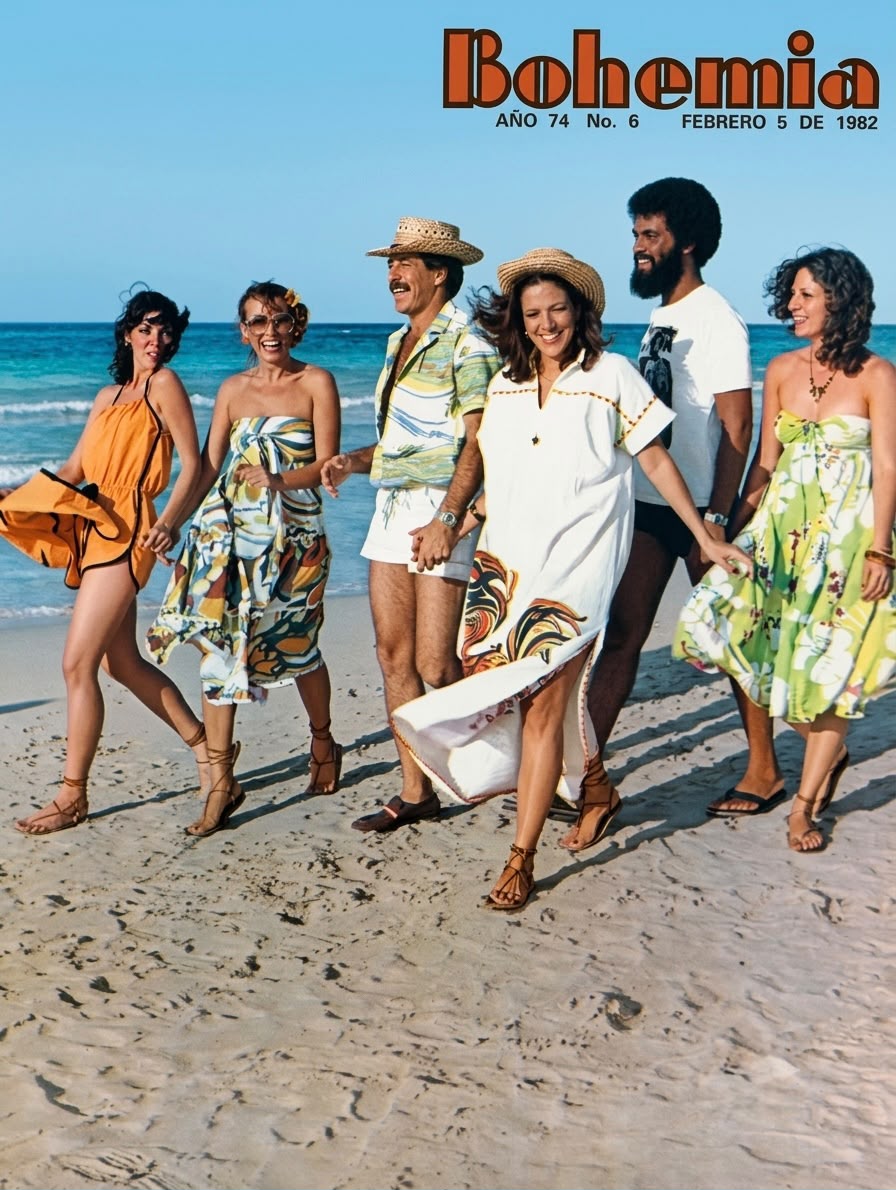
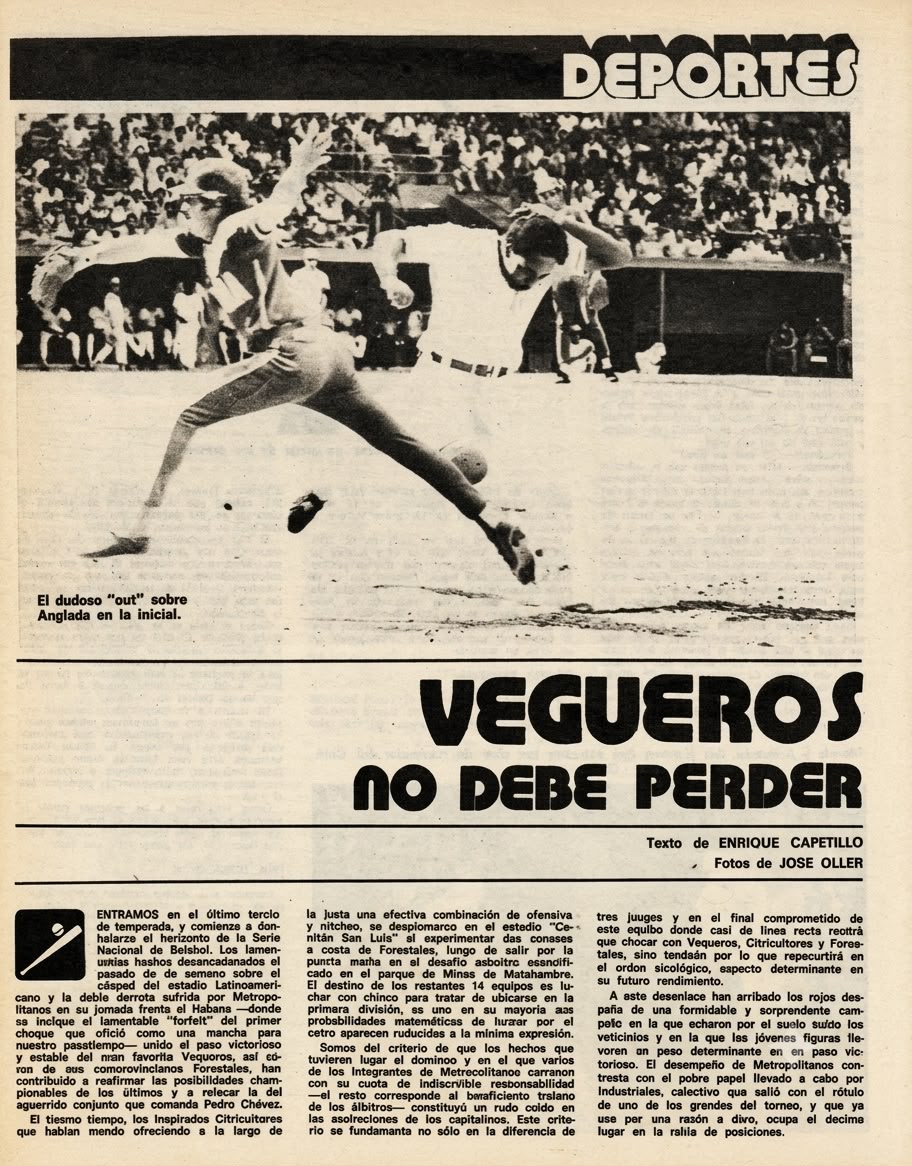
Not long ago an old magazine landed in my hands: an issue of Bohemia, Year 74, No. 6, dated February 5, 1982, with the newspaper archive's stamp still printed on the cover. I was leafing through it looking for something else when a photo in the sports section stopped me. A second baseman stretched out in midair, his body a taut line toward first base, and underneath a six-word caption: “The doubtful ‘out’ on Anglada at first.” It took me a second to understand what I was looking at. That image was one of the last —if not the last— times Rey Vicente Anglada appeared in the Cuban press before they erased him. After that page came silence. Almost twenty years of silence.
It's worth telling why.
The events at the Latino
In that same issue, a few pages later, the magazine ran the account of the scandal: “The Events at the Latino,” bylined by Miguel A. Masjuan and Enrique Capetillo. On Sunday, January 31, 1982, at the Latinoamericano, Metropolitanos and Habana were tied 0-0 into the sixth. Leal, a Habana baserunner, took off to steal second; the throw arrived in time to Anglada's glove, and he brought it down for the out. The umpire called him safe. The ballpark in El Cerro exploded. Manager Pedro Chávez was ejected for protesting too much, and from there everything rolled downhill: umpire Germán Aguila —who a little earlier had called that doubtful out on Anglada at first— started ejecting people one after another, including Anglada himself. The television signal went down in the middle of the melee, there wasn't a single security officer in the stands, and with the game impossible to resume, the umpires declared a forfeit. Metropolitanos, who were fighting for first place, lost the game on paper.
Now then: that's Bohemia's version, and it has to be read knowing what Bohemia was. The Cuban press answered —and still answers— to the government. Its account had every interest in the world in shrinking the embarrassment: a disturbance more noisy than serious, the fault of a single out-of-control fan whom even the players ended up protecting. Those who were at the Latino that afternoon remember something considerably bigger: an entire stadium on its feet, the fury raining down on the umpires, the certainty that Metropolitanos —and Anglada— were being robbed right in front of them. When the only written version belongs to the side that has something to minimize, the testimony of those who were there weighs as much or more.
And at the center of it all, once again, was Anglada: wronged twice by the same umpires in the same game, ejected, arguing toe to toe. So much so that in many people's memory, that scandal came to bear his name.
Who No. 36 was
To measure what was lost, you first have to say what was there. Rey Vicente Anglada Ferrer was born in Carraguao, in El Cerro, on January 6, 1953, a stone's throw from the Latinoamericano. Wearing the blue No. 36, he became one of the best second basemen Cuban baseball has ever seen: a spectacular glove, an instant double-play turn, a baserunner who stole 197 bases in his career and won four stolen-base titles. A contact hitter, .291 lifetime. He was on the national team's preliminary roster without fail from 1974 to 1981; he played World Championships, Central American Games and Pan American Games with the Cuban national team.
René Arocha, who saw him up close, said Anglada would have been on Roberto Alomar's level if they had let him play where the game is played for real. He was even offered a $150,000 professional contract. Hold on to that detail; it will come in handy later.
But the numbers don't fully explain what Anglada was. There were people who went to the Latino just to watch him: to see how he pivoted at second, how he ran, how he turned the impossible into routine. He wasn't just a player people admired; he was a player people loved. And that affection —that ability to move a whole people— would turn out, in the long run, to be the most dangerous thing he had.
March 20, 1982
Seven weeks after that Sunday at the Latino, the matter stopped being about sports.
On March 20, 1982, Granma published an official notice. It spoke of a long and meticulous investigation, of evidence and confessions, of players and coaches guilty of throwing games and running bets. Seventeen active players ended up on the list. Among them, No. 36.
Anglada denied it then and has always denied it. Nothing was ever proven against him —because you can't prove what wasn't done. But in Cuba, proof was never the requirement. He was suspended for life, thrown out of baseball and put in prison: almost three years —two years and eight months, by his account— until they released him without having proven a single one of the accusations.
The math that doesn't add up
There's a calculation the prosecution never managed to explain. Anglada had been offered a $150,000 professional contract, and he said no. He turned down a fortune to keep playing in Cuba, out of pride, for his people, for the blue. And that same man —the one who said no to thousands of dollars out of dignity— was going to sell his name, his career and his honor for a few Cuban pesos in a neighborhood bet? The math doesn't add up. It never did. A man who won't sell out for thousands won't sell out for pennies.
His version, maintained for decades, is that of a plot: there were people bothered by the way he played, and the real discovery of a betting ring was the perfect occasion to take him out of circulation. He summed it up bluntly: his only crime was that he played, thought and dressed like a professional. In that Cuba, that was charge enough.
The crime of being loved
Here I'm entering the realm of hypothesis, and I want to say so plainly: what follows is interpretation, not case file.
Let's put the two dates side by side. In January 1982, Anglada is at the center of the year's loudest scandal at the Latino: a wronged idol, a stadium on fire, a national broadcast cut off, a game that had to be called. In March 1982, just weeks later, that same man is accused, suspended for life and jailed. A coincidence on the calendar? Maybe. But it's worth asking.
Because you have to understand what kind of country that Cuba was: a stage with a single leading man. Under Fidel Castro's dictatorship, popular fervor had only one permitted direction —the Comandante, the center, the only one authorized to fill a plaza. Anything that shone too brightly outside that orbit was competition. And a second baseman capable of bringing an entire stadium to its feet wasn't just a sports idol: he was, without meaning to be, a rival for the one thing that system never hands out —the genuine love of the people. Regimes like that don't argue with those people. They switch them off.
Anglada himself has said it his own way for years: that his fault was playing, thinking and dressing like a professional. I would add one more layer. Perhaps his greater fault was being loved with that intensity, to the point of setting a stadium ablaze. The betting ring was real, and for someone it was the perfect opportunity. But the question remains: how much did it weigh, in the decision to take him out of circulation, that his name alone could set El Cerro on fire?
I can't prove it. Nobody ever signed an order with that motive in writing. But forty years later, with that photo and that date so close together, I find it hard to believe that fear of his popularity had nothing to do with it.
The shadow of Garbey
One name hovers over this whole story: Bárbaro Garbey.
Garbey was Anglada's teammate on that Industriales club of the seventies, a tremendous hitter who led the Serie Nacional —Cuba's National Series— in RBIs in 1978. That same year he was accused of exactly what Anglada would later be accused of —throwing games, betting— and was jailed, and his name was erased from the Cuban record books in 1979. The template for the punishment already existed. They had debuted it with him. But Garbey did what the regime does not forgive: in 1980 he got on a boat in the Mariel boatlift and left. He signed with the Detroit Tigers, and although his glory would come a little later —1984, his major league debut and a World Series title as a rookie, the first Cuban-developed player to reach the majors since Tony Pérez— by 1982 he was already the worst of precedents: living proof that a player they had branded could get out and be reborn on the other side.
It's worth drawing a line here, one Anglada himself never stopped drawing: that there were people throwing games didn't make him guilty of anything. He never had any part in it, and the contrary could never be proven. His closeness with Garbey wasn't complicity: it was friendship, and above all it was an uncomfortable example. For an apparatus that already feared losing its most beloved second baseman, having him tied to a man who had left and was succeeding in the enemy's baseball wasn't a detail: it was an alarm. They didn't want another Garbey. And Anglada —loved, admired, capable of lifting a stadium— was the perfect candidate to become one.
So they buried him before he could leave.
The erasure
After March 20, Rey Vicente Anglada disappeared from the Cuban press as if he had never existed. No farewell, no tribute, no closing statistics. A Cuban national team idol, wiped out with a stroke of the pen. And that erasure is no minor detail: it's the same machinery that had played down the riot at the Latino in February, now applied to an entire man. The press that answers to power shows up twice in this story doing the same thing: covering up.
Anglada spent the following years as an electrician and a truck driver. The best second baseman of his generation, driving trucks, while his name rotted in an official silence that would last almost twenty years.
The vindication nobody signed
In 2001 they called him back. Not to play —it was too late for that, and that debt can't be repaid— but to manage. And El Rey took Industriales to the top: champions in 2003, champions in 2004, champions in 2006. Then he managed the Cuban national team.
The fans understood the message the authorities never dared to say out loud. Giving him back the uniform and putting him in charge of the biggest team in the country was, between the lines, a confession that an injustice had been committed against him. The vindication happened. The public apology, never. In Cuba, people are rehabilitated without anyone ever admitting they were destroyed.
Anyone who wants to hear it in his own voice can look up the documentary El juego de Cuba (2001), by Manuel Martín Cuenca, in which Anglada appears alongside Jorge Perugorría and Luis Alberto García, telling what the island's press had stolen from him for two decades. The director described his film as the story of the great illusion, of what might have been. I don't know a more accurate description of Rey Vicente Anglada's career.
The name
That 1982 caption was right: it was a doubtful out. Except the story didn't end at first base.
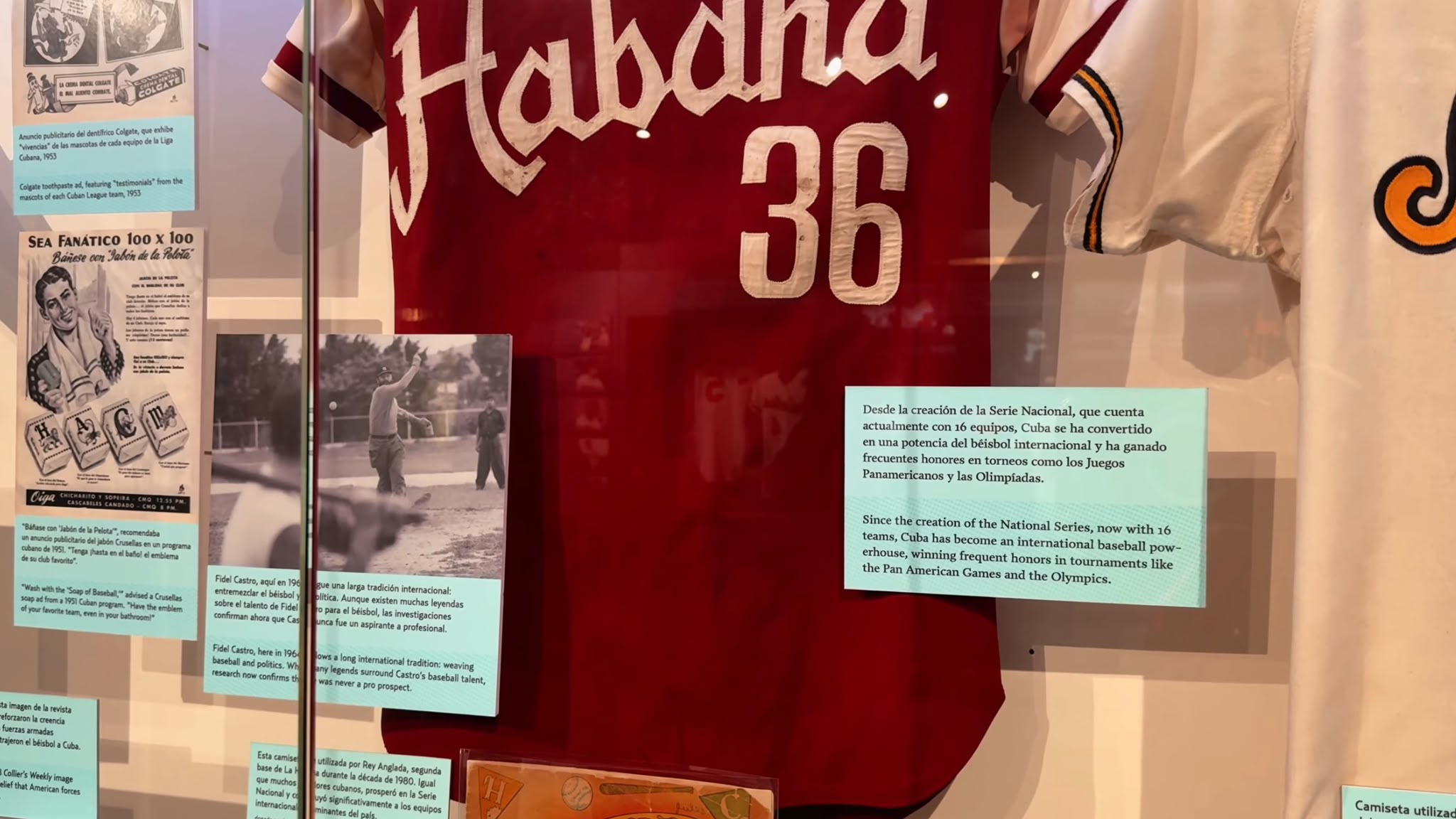
In January, when the umpires got it wrong, the stadium burned, the television went dark, and the whole country knew that same night. In March, when the umpire was the state, nothing burned: no grandstand could leap onto the field. That's the whole difference between a sporting injustice and a state injustice. The first, the people shout out on the spot; the second takes forty years and someone willing to tell it. And there's an image that crowns all of this better than any argument. I saw it with my own eyes, in Cooperstown, at baseball's Hall of Fame. In the Cuba section of the ¡Viva Baseball! exhibit, behind glass, hangs a maroon Habana jersey with a 36 on the back. The label, in Spanish and English, leaves no room for doubt: it's the one worn by Rey Anglada, Havana's second baseman, in the 1980s.
Stop for a second on what that means. The man the regime accused, jailed and erased from its own press today has his jersey hanging in baseball's highest cathedral, without ever having played in the major leagues. And in that same display case, next to his jersey, another museum label makes clear —research in hand— that Fidel Castro was never the baseball prospect the propaganda invented. There it is, summed up behind glass in New York, the verdict Cuba never wanted to sign: the real idol was Anglada.
They tried to switch off Rey Vicente Anglada for one underlying reason: he shone too brightly for a country where only one man had permission to shine. They took away his career, his freedom and, for twenty years, even his name. Nobody can give him back his career. His name, yes: that's why I'm writing this.
Because on the only play that truly matters, the judgment of history, Anglada was always safe.
Originally published in Spanish on Recta Al Pecho.